DonateMembershipVisit Heritage
  • Tūrangawaewae
    Places
  • Tira Māori
    Māori Heritage
  • Poutairangahia
    Archaeology
  • Rauemi
    Resources
  • Mō Tātou
    About Us
  • New Zealand Heritage List
  • Nominate and submit
  • Explore the List
  • National Historic Landmarks
  • Plaques
  • Rainbow List Project
  • Lost heritage
  • Visit Heritage
  • Our properties
  • Turnbull House Project
  • Collections
  • Shop
  • Tohu Whenua
  • Tira Māori
  • Conserving Māori heritage
  • Marae built heritage
  • Māori heritage on the List
  • Hinemihi—Te Hokinga Mai
  • What is archaeology?
  • Is there a site on my property?
  • What are my legal requirements?
  • Affecting an archaeological site
  • Declaring an archaeological site
  • Archaeology FAQs
  • Archaeology Digital Library
  • Archaeology guidelines and templates
  • Resources
  • Funding
  • Publications
  • Sustainable management guides
  • Disaster recovery
  • Podcasts & digital resources
  • Education Hub
  • Conservation plans
  • About
  • Board
  • Māori Heritage Council
  • Senior Staff
  • Offices
  • Contact us
  • Careers
  • Covenants
  • Fast-track
  • Corporate documents
  • Currently consulting on
  • Our submissions
  • News
  • Covid-19 response
Quick links
Rārangi Kōrero | The List
Explore the List
National Historic Landmarks
Ngā Manawhenua o Aotearoa me ōna Kōrero Tūturu
Quick links
Tapuwae
A Vision for Places of Māori Heritage
Funding for Māori Heritage
Resources
Quick links
Archaeological Authority Portal
Applying for an archaeological authority
Archaeology FAQs
Browse the most frequently asked questions about archaeological authorities and the archaeological process.
Quick links
Quick links
News
News Keep up to date with Heritage New Zealand Pouhere Taonga
Membership
Membership Find out more and sign up today
DonateMembershipVisit Heritage
  • Tūrangawaewae
    Places
  • Tira Māori
    Māori Heritage
  • Poutairangahia
    Archaeology
  • Rauemi
    Resources
  • Mō Tātou
    About Us
  • New Zealand Heritage List
  • Nominate and submit
  • Explore the List
  • National Historic Landmarks
  • Plaques
  • Rainbow List Project
  • Lost heritage
  • Visit Heritage
  • Our properties
  • Turnbull House Project
  • Collections
  • Shop
  • Tohu Whenua
  • Tira Māori
  • Conserving Māori heritage
  • Marae built heritage
  • Māori heritage on the List
  • Hinemihi—Te Hokinga Mai
  • What is archaeology?
  • Is there a site on my property?
  • What are my legal requirements?
  • Affecting an archaeological site
  • Declaring an archaeological site
  • Archaeology FAQs
  • Archaeology Digital Library
  • Archaeology guidelines and templates
  • Resources
  • Funding
  • Publications
  • Sustainable management guides
  • Disaster recovery
  • Podcasts & digital resources
  • Education Hub
  • Conservation plans
  • About
  • Board
  • Māori Heritage Council
  • Senior Staff
  • Offices
  • Contact us
  • Careers
  • Covenants
  • Fast-track
  • Corporate documents
  • Currently consulting on
  • Our submissions
  • News
  • Covid-19 response
Quick links
Rārangi Kōrero | The List
Explore the List
National Historic Landmarks
Ngā Manawhenua o Aotearoa me ōna Kōrero Tūturu
Quick links
Tapuwae
A Vision for Places of Māori Heritage
Funding for Māori Heritage
Resources
Quick links
Archaeological Authority Portal
Applying for an archaeological authority
Archaeology FAQs
Browse the most frequently asked questions about archaeological authorities and the archaeological process.
Quick links
Quick links
News
News Keep up to date with Heritage New Zealand Pouhere Taonga
Membership
Membership Find out more and sign up today
  • Places
  • Nominate and submit
  • National Historic Landmarks
  • Places
  • Nominate and submit
  • National Historic Landmarks
  • Tira Māori
  • Conserving Māori heritage
  • Marae built heritage
  • Tira Māori
  • Conserving Māori heritage
  • Marae built heritage
  • Archaeological authorities
  • Archaeology Digital Library
  • Archaeological authorities
  • Archaeology Digital Library
  • All resources
  • Publications
  • Funding
  • All resources
  • Publications
  • Funding
  • FAQs
  • FAQs
Follow us on:
Places
  • Places
  • Nominate and submit
  • National Historic Landmarks
Tira Māori
  • Tira Māori
  • Conserving Māori heritage
  • Marae built heritage
Archaeology
  • Archaeological authorities
  • Archaeology Digital Library
Resources
  • All resources
  • Publications
  • Funding
FAQs
  • FAQs
Follow us on
HomePrivacyTerms and conditionsAbout this site
© Heritage New Zealand Pouhere Taonga 2026.
 
Wonderland Statue

Oamaru Public Gardens, 39 Chelmer Street, OAMARU

Public

Historic Place Category 2

List No. 7149

Quick links:
List GalleryLocationDetails
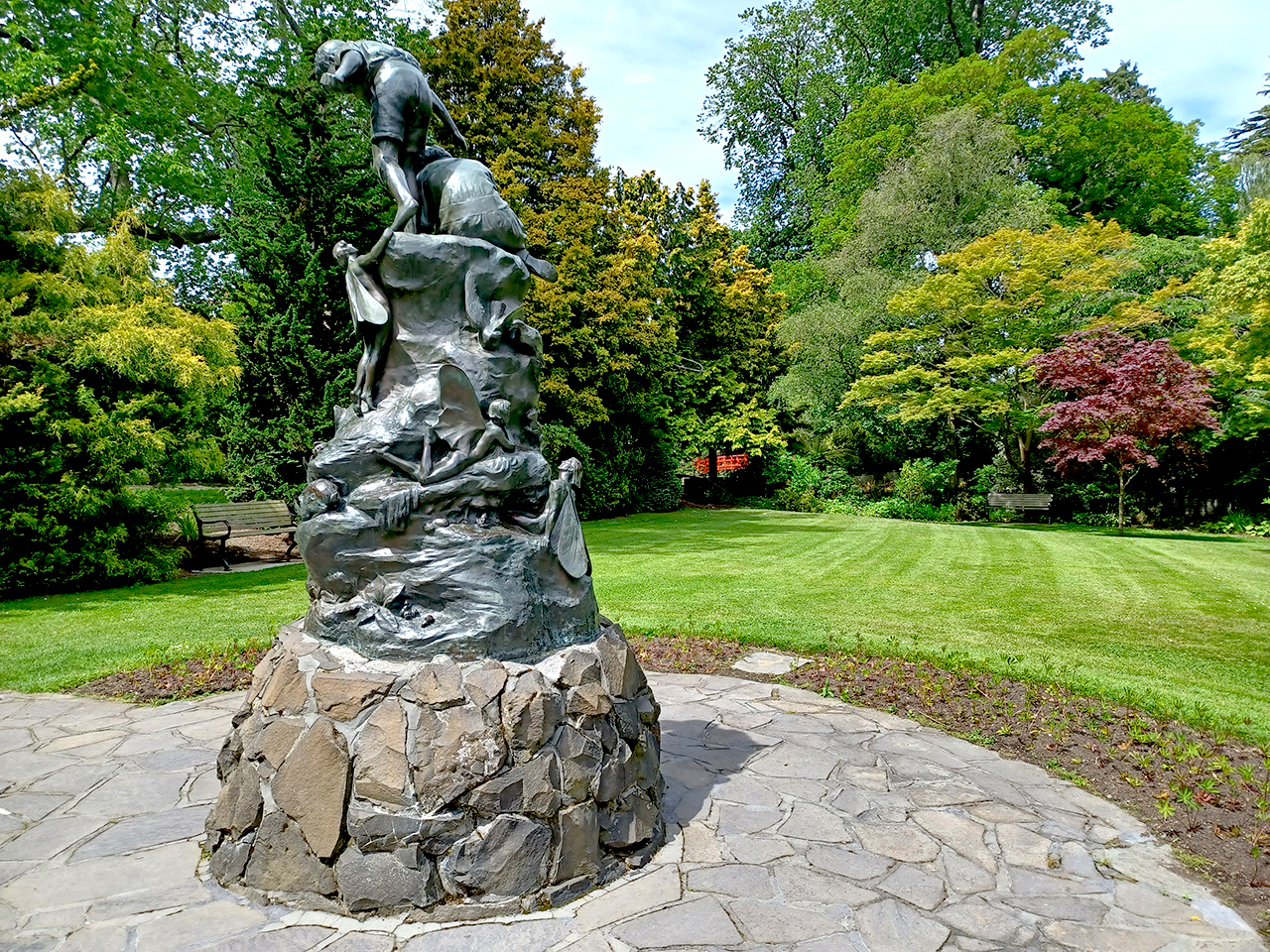
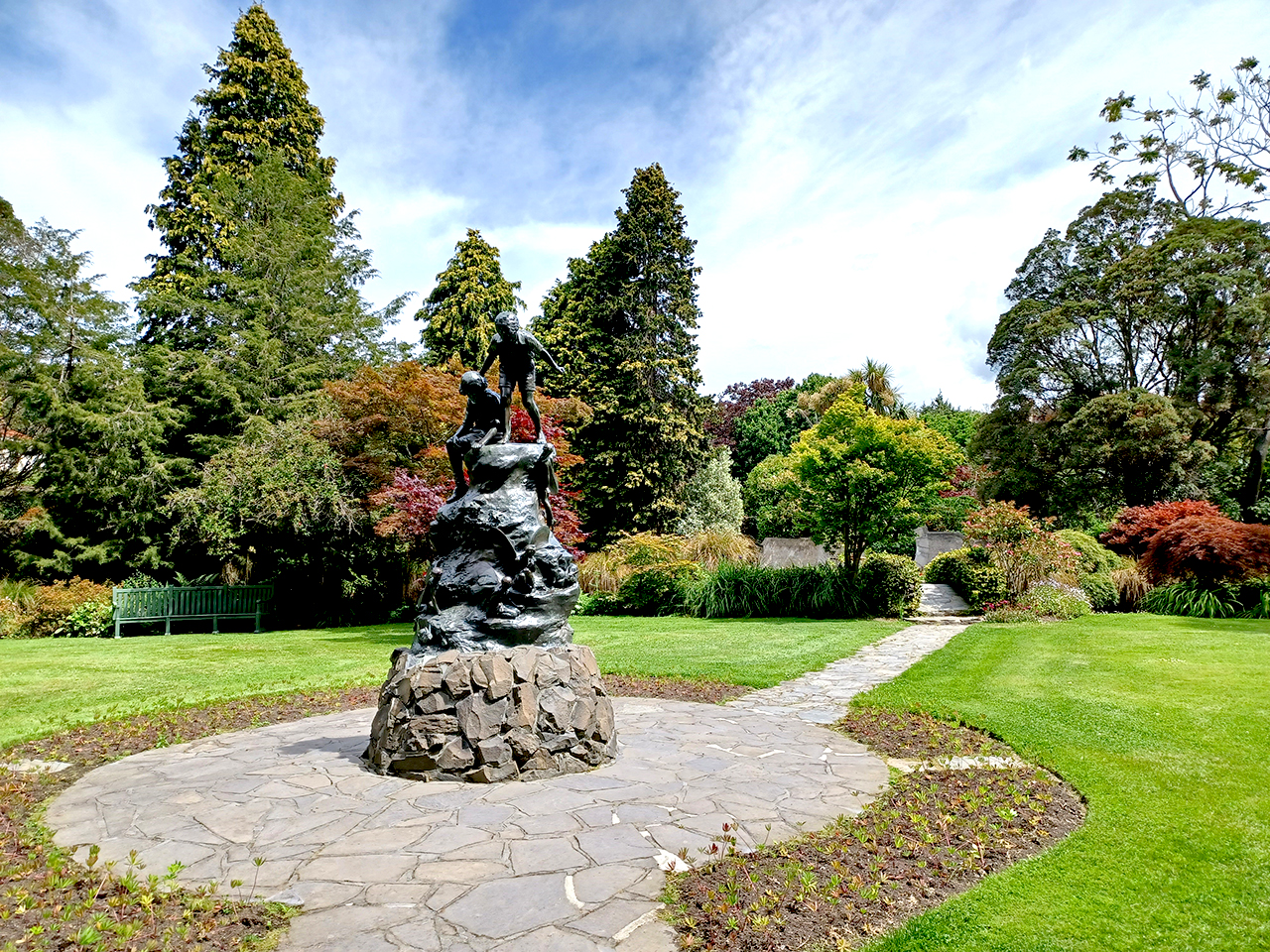
Unveiled in 1927, the Wonderland Statue in the Oamaru Public Gardens, depicting a boy and a girl absorbed by the fairy land revealed to them, recalls the curiosity and imagination of childhood. Sculpted by renowned Scottish sculptor Sir Thomas Clapperton and inspired by Sir George Frampton’s 1913 Peter Pan sculpture in London’s Kensington Gardens, the statue has historic, cultural and social significance.

Oamaru’s Wonderland Statue owes it allegiance to Sir George Frampton’s Peter Pan unveiled in Kensington Gardens in London in 1913. The sculptor, Sir Thomas Clapperton, was a former student of Frampton’s. Clapperton completed some prestigious commissions in England and other work in New Zealand. Clapperton’s other works include a statue of Robert the Bruce at the entrance to Edinburgh Castle, and an equestrian statue of a raider in his home town of Galasheils at the Scottish Borders. He also designed the bronze soldier for the First World War Memorial on Thames Street in Oamaru (List Entry No. 2316).

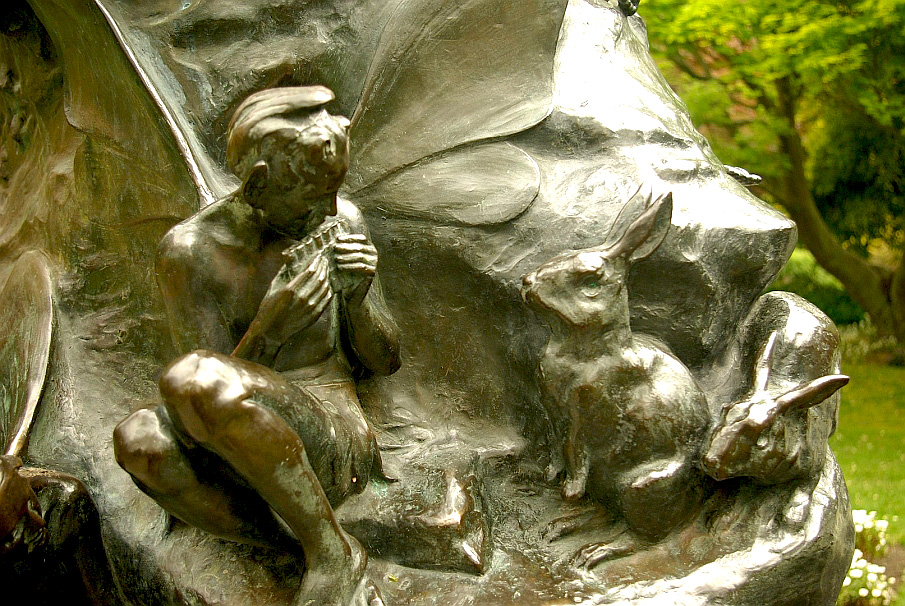
The sculpture was commissioned by Robert Milligan, a former mayor of Oamaru. Milligan had seen Frampton’s Peter Pan at Kensington Gardens, and entranced by it, wanted to bring the spirit of the work to Oamaru. The sculpture was cast in bronze at the foundry of A.B. Burton in London. The marquette, or model for the sculpture, is in a private collection. Milligan’s gift inspired at least one child who had gazed and the children and stroked the bronze nose of the small animals: Harold Richmond, who had grown up in Oamaru, commissioned the Peter Pan sculptures for the Dunedin Botanic Gardens in the 1960s.

In March 1927, two thousand people crowded into the gardens to witness the unveiling of ‘A Vision of Fairyland’ statue.’ The sculpture shows a boy and a girl on top of a rock entranced by the fairy world they can see below – finely detailed fairies and small animals. Although it does not depict any of the Peter Pan characters, the statue has acquired the name ‘Wonderland Statue.’ Oamaru’s statue seems to be the earliest of that genre in New Zealand, predating those at Wanganui (1967), Invercargill (1966), Dunedin (1965 and 1968) and Hawera (1951, List Entry No. 7469). Oamaru’s sculpture is also the least literal –the others depict characters from Peter Pan – and represents childhood imagination and wonder.

In 1959 a special Wonderland Garden was designed by Mr H.T. Beveridge, the superintendent of the reserves department. In November 1959, the Wonderland Garden opened with the statue on a new, less rustic base.
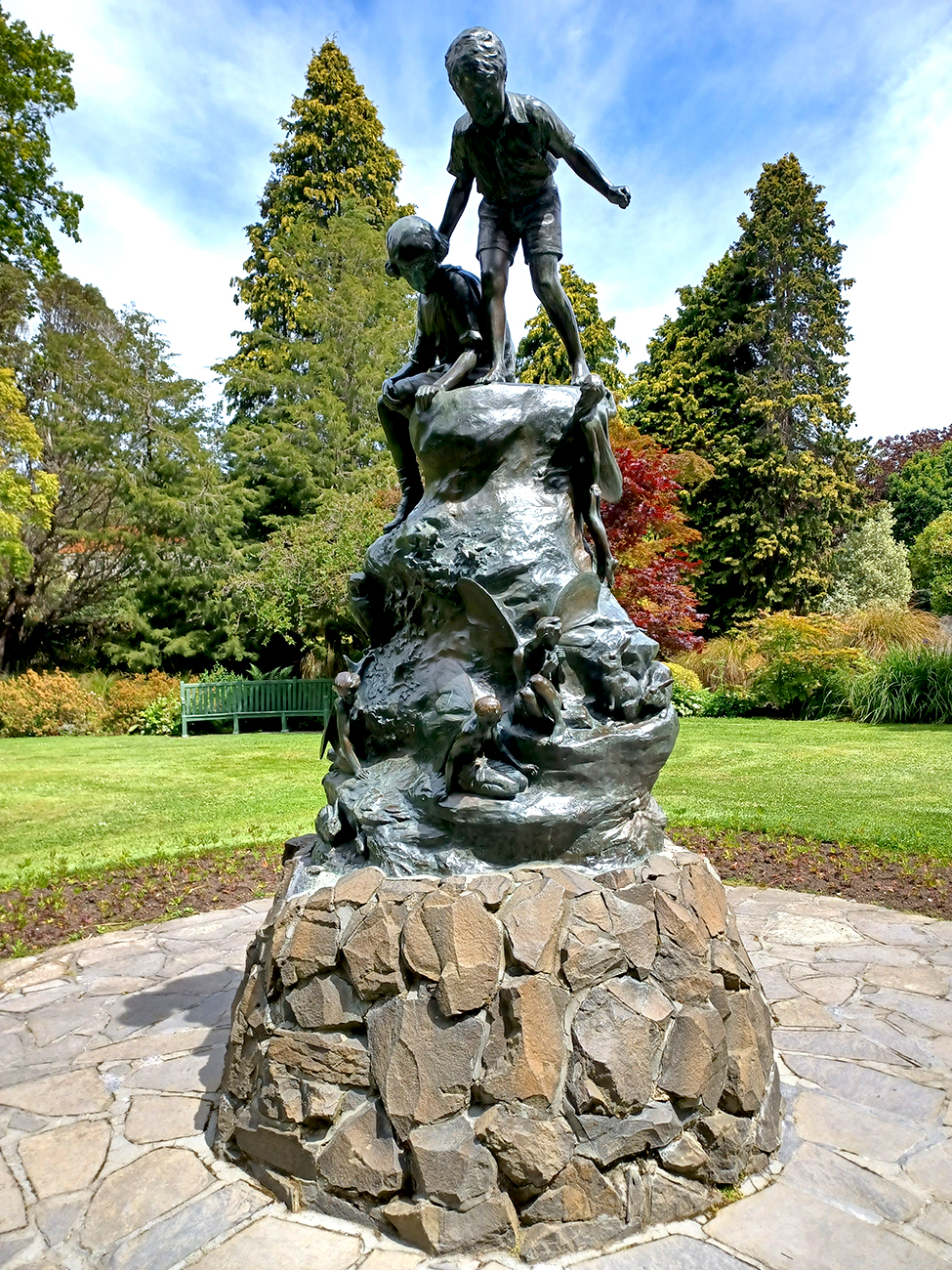
Wonderland Statue, Oamaru Public Gardens, Oamaru | Sarah Gallagher | 08/12/2023 | Heritage New Zealand Pouhere Taonga
Wonderland Statue, Oamaru Public Gardens, Oamaru. CC BY 2.0 Image courtesy of commons.wikimedia.org | Samuel Mann | 24/10/2010 | Samuel Mann - Wikimedia Commons
Wonderland Statue, Oamaru Public Gardens, Oamaru | Sarah Gallagher | 08/12/2023 | Heritage New Zealand Pouhere Taonga
Wonderland Statue, Oamaru Public Gardens, Oamaru. CC BY 2.0 Image courtesy of commons.wikimedia.org | Samuel Mann | 24/10/2010 | Samuel Mann - Wikimedia Commons

List Entry Information

Overview

Status
Listed

List Entry Status
Historic Place Category 2

Access
Able to Visit

List Number
7149

Date Entered
24th February 1994

Date of Effect
24th February 1994

City/District Council
Waitaki District

Region
Otago Region

Extent of List Entry

Extent includes part of the land described as Lot 2 DP 317966 (RT 70398), Otago Land District, and the structure known as the Wonderland Statue thereon. (Refer to the extent map tabled at the Heritage List/ Rārangi Kōrero Committee meeting on 11 February 2016).

Legal description

Lot 2 DP 317966 (RT 70398), Otago Land District

Detailed List Entry

Construction Professional

Name

T. Clapperton

Type

Sculptor

Biography

Thomas Clapperton (1879-1962) was a Scottish sculptor trained at the Galashiels Mechanics Institute, the Glasgow School of Art and the Kennington School of Art. After receiving a travelling scholarship he returned to London where he set up studios. Among his commission were war memorials, including in Canobie, Minto, Galashiels and Selkirk. His work abroad included Oamaru’s war memorial, sculpture in Canada, and a fountain in California. His most well known work in Scotland is the statue of Robert the Bruce at the entrance to Edinburgh Castle (1929). He completed other public monuments and friezes in Scotland and England.

Construction Details

Start Year

1927

Type

Original Construction

Description

Presented to the children of Oamaru by former Mayor Robert Milligan March 1926

Start Year

1959

Type

Modification

Description

Statue given new base and setting in Wonderland Garden

Reference

Completion Date

11th January 2016

Report Written By

Heather Bauchop

Report Written By

This place was identified as significant under previous legislation with different information requirements. It remains significant under the current legislation. There is opportunity under our legislation and policies to add to this information. Further information about this place may be available from the Otago/Southland Office of Heritage New Zealand Pouhere Taonga. A copy of the original report is available from the NZHPT Southern region office Please note that entry on the New Zealand Heritage List/Rarangi Korero identifies only the heritage values of the property concerned, and should not be construed as advice on the state of the property, or as a comment of its soundness or safety, including in regard to earthquake risk, safety in the event of fire, or insanitary conditions. A fully referenced upgrade report is available on request from the Otago/Southland Office of Heritage New Zealand

Further Information

Current Usages

Uses: Civic Facilities

Specific Usage: Statue/public art

Former Usages

Themes

Web Links

Overview

Status

Listed

List Entry Status

Historic Place Category 2

Access

Able to Visit

List Number

7149

Date Entered

24th February 1994

Date of Effect

24th February 1994

City/District Council

Waitaki District

Region

Otago Region

Extent of List Entry

Extent includes part of the land described as Lot 2 DP 317966 (RT 70398), Otago Land District, and the structure known as the Wonderland Statue thereon. (Refer to the extent map tabled at the Heritage List/ Rārangi Kōrero Committee meeting on 11 February 2016).

Legal description

Lot 2 DP 317966 (RT 70398), Otago Land District

Status

Listed

List Entry Status

Historic Place Category 2

Access

Able to Visit

List Number

7149

Date Entered

24th February 1994

Date of Effect

24th February 1994

City/District Council

Waitaki District

Region

Otago Region

Extent of List Entry

Extent includes part of the land described as Lot 2 DP 317966 (RT 70398), Otago Land District, and the structure known as the Wonderland Statue thereon. (Refer to the extent map tabled at the Heritage List/ Rārangi Kōrero Committee meeting on 11 February 2016).

Legal description

Lot 2 DP 317966 (RT 70398), Otago Land District

Construction Information

Construction Professional

Name

T. Clapperton

Type

Sculptor

Biography

Thomas Clapperton (1879-1962) was a Scottish sculptor trained at the Galashiels Mechanics Institute, the Glasgow School of Art and the Kennington School of Art. After receiving a travelling scholarship he returned to London where he set up studios. Among his commission were war memorials, including in Canobie, Minto, Galashiels and Selkirk. His work abroad included Oamaru’s war memorial, sculpture in Canada, and a fountain in California. His most well known work in Scotland is the statue of Robert the Bruce at the entrance to Edinburgh Castle (1929). He completed other public monuments and friezes in Scotland and England.

Construction Details

Start Year

1927

Type

Original Construction

Description

Presented to the children of Oamaru by former Mayor Robert Milligan March 1926

Start Year

1959

Type

Modification

Description

Statue given new base and setting in Wonderland Garden

Construction Professional

Name

T. Clapperton

Type

Sculptor

Biography

Thomas Clapperton (1879-1962) was a Scottish sculptor trained at the Galashiels Mechanics Institute, the Glasgow School of Art and the Kennington School of Art. After receiving a travelling scholarship he returned to London where he set up studios. Among his commission were war memorials, including in Canobie, Minto, Galashiels and Selkirk. His work abroad included Oamaru’s war memorial, sculpture in Canada, and a fountain in California. His most well known work in Scotland is the statue of Robert the Bruce at the entrance to Edinburgh Castle (1929). He completed other public monuments and friezes in Scotland and England.

Construction Details

Start Year

1927

Type

Original Construction

Description

Presented to the children of Oamaru by former Mayor Robert Milligan March 1926

Start Year

1959

Type

Modification

Description

Statue given new base and setting in Wonderland Garden

Reference

Historical and Associated Iwi / Hapū / Whānau

Completion Date

11th January 2016

Report Written By

Heather Bauchop

Other Information

This place was identified as significant under previous legislation with different information requirements. It remains significant under the current legislation. There is opportunity under our legislation and policies to add to this information. Further information about this place may be available from the Otago/Southland Office of Heritage New Zealand Pouhere Taonga. A copy of the original report is available from the NZHPT Southern region office Please note that entry on the New Zealand Heritage List/Rarangi Korero identifies only the heritage values of the property concerned, and should not be construed as advice on the state of the property, or as a comment of its soundness or safety, including in regard to earthquake risk, safety in the event of fire, or insanitary conditions. A fully referenced upgrade report is available on request from the Otago/Southland Office of Heritage New Zealand

Historical and Associated Iwi / Hapū / Whānau

Completion Date

11th January 2016

Report Written By

Heather Bauchop

Other Information

This place was identified as significant under previous legislation with different information requirements. It remains significant under the current legislation. There is opportunity under our legislation and policies to add to this information. Further information about this place may be available from the Otago/Southland Office of Heritage New Zealand Pouhere Taonga. A copy of the original report is available from the NZHPT Southern region office Please note that entry on the New Zealand Heritage List/Rarangi Korero identifies only the heritage values of the property concerned, and should not be construed as advice on the state of the property, or as a comment of its soundness or safety, including in regard to earthquake risk, safety in the event of fire, or insanitary conditions. A fully referenced upgrade report is available on request from the Otago/Southland Office of Heritage New Zealand

Further Information

Current Usages

Uses: Civic Facilities

Specific Usage: Statue/public art

Current Usages

Uses: Civic Facilities

Specific Usage: Statue/public art

Location

Loading
Related listings
Craig Memorial Fountain, Oamaru Public Gardens
Craig Memorial Fountain
Greenhouse, Oamaru Public Gardens
Greenhouse
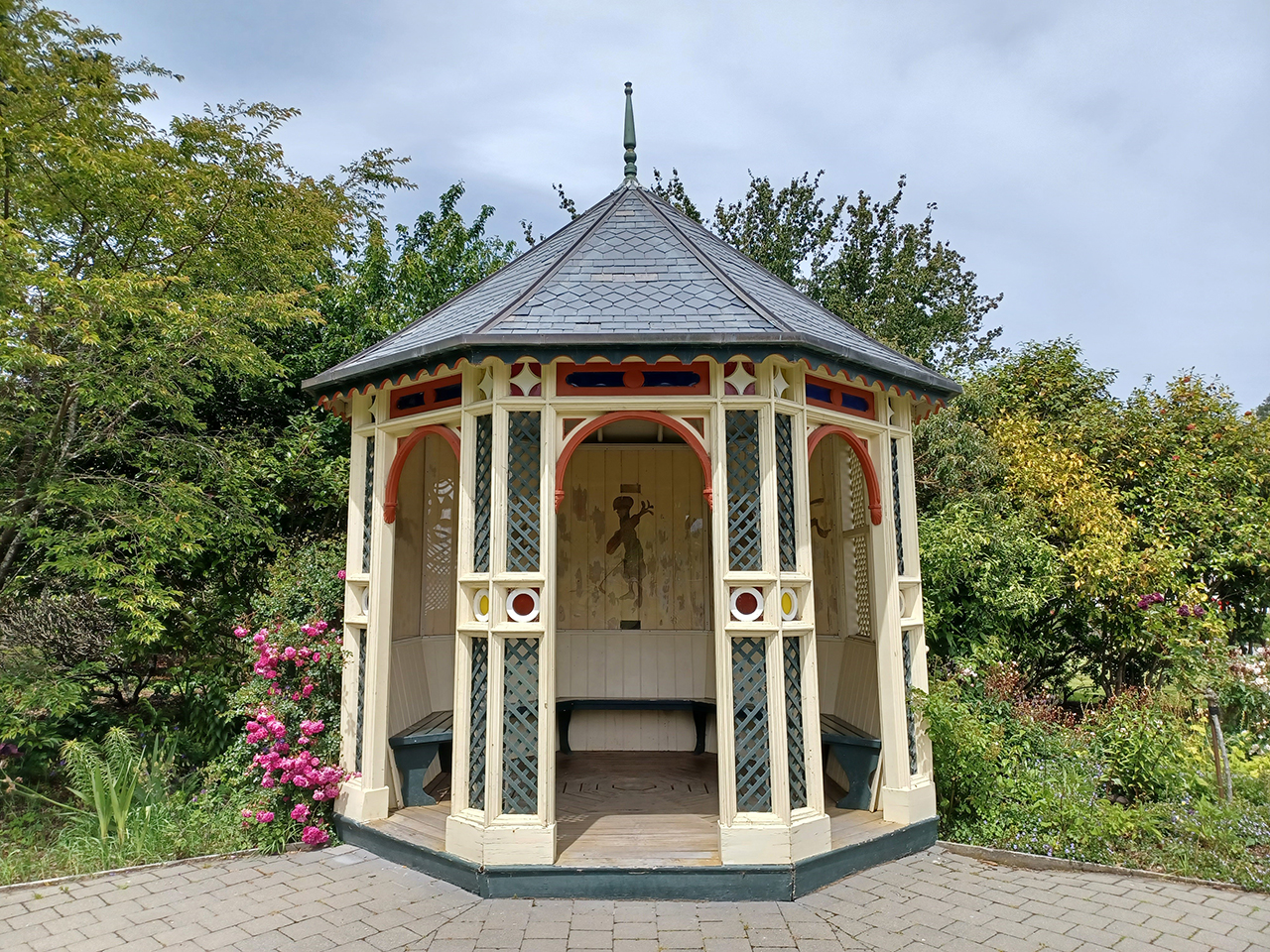
Elderslie Summer House, Oamaru Public Gardens, Oamaru
Elderslie Summer House
Japanese Red Bridge, Oamaru Public Gardens, Oamaru
Japanese Red Bridge
Band Rotunda, Oamaru Public Gardens
Band Rotunda
Elderslie Summer House, Oamaru Public Gardens, Oamaru
Elderslie Summer House
Craig Memorial Fountain, Oamaru Public Gardens
Craig Memorial Fountain
Japanese Red Bridge, Oamaru Public Gardens, Oamaru
Japanese Red Bridge
Greenhouse, Oamaru Public Gardens
Greenhouse
Band Rotunda, Oamaru Public Gardens
Band Rotunda
Stay up to date with Heritage this month